Why Films Get Grouped Into Collections
Why films get grouped into collections can clarify what connects them, helping you choose a viewing path that fits your interest without assuming every title belongs together.
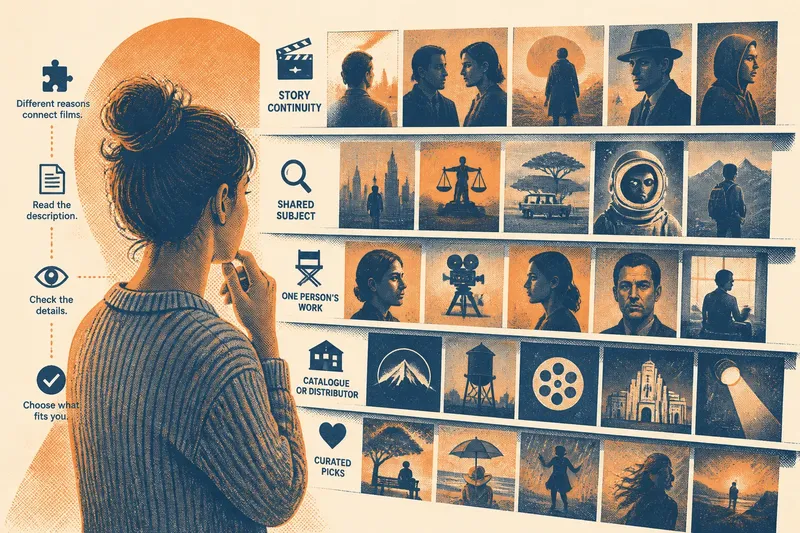
You open a streaming app to find one film and see it beside sequels, a director collection, and a row called “curated picks.” Why films get grouped into collections depends on the connection the label is meant to show: story, subject, availability, or a shared theme. Knowing the difference helps you choose without treating every row as a viewing order.
Match the collection
Start with what you want from the films. A collection is useful when its organizing idea matches your reason for browsing.
- Story continuity: Check descriptions for returning characters, plot links, or terms such as “sequel” and “prequel.” If the films continue one story, consider the stated sequence; if they share only a world or title, choose based on your interest.
- Shared subject: Read the descriptions and classifications. If the films approach the subject in a way that suits you, keep browsing; otherwise, look for a narrower theme.
- One person’s work: Check whether the collection names a director, writer, performer, or another contributor. If that connection interests you, browse the titles; if you want one particular kind of work, inspect the collection description for its selection criteria.
- Catalogue or distributor: Look for a studio, distributor, streaming service, or home-video label. If you want to browse its available titles, use the collection; if you want films linked by story or subject, search for that connection separately.
- Curated recommendations: Read the curator’s stated theme or rationale. If it matches your mood or interests, consider a title; if the explanation is vague, treat the row as a starting point and assess each film individually.
- Unclear grouping: Check the page heading and the individual descriptions. If they identify a shared basis, browse on that basis; if not, select titles one at a time rather than assuming a sequence.
A collection label is like a divider on a bookshelf: it points you toward a group, but it does not tell you that every item belongs there for the same reason.
Story-based sets
A series or franchise collection may connect films through a continuing plot, recurring characters, a setting, or a familiar premise. Those links are not interchangeable. Some entries continue the same storyline; others tell a separate story in a shared fictional world.
Look for descriptions that identify sequels, prequels, spin-offs, or standalone entries. A franchise name by itself does not tell you how much context a film needs. If the platform or packaging gives an order, consider whether it is based on release sequence or fictional chronology. Release order is a clear option when you want to encounter the films as they were originally presented; chronology may suit you better when following events in story time is your priority.
Creator collections
A collection named for a filmmaker, performer, writer, or other contributor can help you find films connected to that person. The grouping may cover different kinds of work, however, and does not necessarily mean every title has the same style or purpose.
Read the collection description to see what it includes. A person’s name may signal a broad selection, a particular role, or an editorial theme. If you want a focused set, compare the description with your aim before choosing a title. The useful question is not whether all the films are alike, but whether the stated connection is the one you came looking for.
Say you want films by a particular director, and a collection includes a title described as part of that person’s broader filmography. You check the platform’s description and see that the collection brings together films linked to the director’s career, not only directing work. You keep the titles described as directed by that person for your viewing plan and leave the broader collection entry for another time. The result is a narrower list that matches your original interest.
Theme and catalogue
Themed collections bring films together around a subject, genre, place, season, or mood. They can offer variety rather than a connected story. Two films under a label such as “mystery” may take very different approaches, so read the descriptions and classifications when tone or suitability matters to your choice.
A catalogue collection may reflect what a distributor, studio, platform, or home-video label has assembled or made available. Its titles do not necessarily share a plot or theme. Use the grouping to browse that catalogue, then decide whether each film fits your interests.
One title can belong to several groupings at once. A film might be part of a series, appear in a seasonal theme, and be offered through a particular distributor. Each label describes a different connection, so use the one that answers your current question.
Which collection fits your search?
Does a series collection show the right viewing order?
Not always. Check whether the page or descriptions state release order, story chronology, or another sequence. If no order is given, choose based on whether you value original release sequence or events in fictional time.
Does a themed collection mean the films are alike?
Only in the broad sense indicated by the theme. Read individual descriptions and classifications if you want to know whether a title’s approach, tone, or suitability fits your plans.
Can one film appear in several collections?
Yes. A film can be grouped by story, subject, catalogue, or another connection at the same time. Choose the label that best answers why you are browsing.
What should I do if the collection label is vague?
Check the collection description and the film descriptions for a shared basis. If they do not explain the connection, treat the row as a browsing suggestion rather than a sequence or a firm statement about the films.
Read beyond the label
Before choosing, look at the collection name, its description, any stated sequence, and the details for the individual titles. A numbered set may suggest an order, while a shared heading may simply gather options. If the description does not explain the connection, avoid assuming that it does.
Why films get grouped into collections is only part of the choice; the label helps explain why titles sit together, while each film’s description helps you decide whether it suits your viewing plans. Use the collection as a path into the catalogue, not as a substitute for choosing title by title.